Murder Mystery Horror Games to Play This Halloween
Murder Mystery Horror Games to Play This Halloween Halloween horror doesn’t always chase you down a corridor. Sometimes it hands...
Read More →

Published May 5, 2026 — Updated May 5, 2026 · 16-minute read
The horror sits in a sentence. Not in a corridor, not in a basement, not in a creature pattern you have to learn — in a sentence, on a screen, that does something to you while you're reading it. That's the specific job narrative horror games do, and the best of them have been quietly stacking up for the past five years while the rest of the genre was busy with monsters. Below you'll find twelve of them, ranked by how thoroughly the writing carries the dread. Visual novels share the list with isometric RPGs, point-and-click adventures, and one third-person art-house piece about a nun and the Devil. The common thread isn't format. It's that every one of them earns its scares through prose, choice, and silence.
One of those twelve is a 2026 release: a French interactive novel called Maximilien, due October 26. We'll get to it in position 4. We're including it because, on the strength of its demo and pre-release material, it belongs in the conversation — not because we run the website.
Quick answer: The best narrative horror games in 2026 use writing as their primary horror mechanic. Top picks include Slay the Princess — The Pristine Cut, Disco Elysium, 1000xResist, Mouthwashing, and Indika. For visual novel newcomers, start with Doki Doki Literature Club Plus! or Scarlet Hollow. For 2026 releases, watch Maximilien, a hand-written interactive novel set in 1920s Boston, due October 26.
The term gets stretched. We're using it tightly. A narrative horror game is one where the horror lives in the writing — the dialogue, the structure, the choices, the silences between paragraphs — and not in pursuit sequences, jump scares, or weapon management. Combat is optional or absent. Reading is the main verb.
Three quick markers separate the genre from cousin genres like survival horror or cosmic horror:
If you've read our piece on the 18 best psychological horror games of 2026, you'll notice some overlap and some pointed differences. Silent Hill 2, Visage, Outlast 2 — all psychological horror, none narrative horror in the strict sense. Norco, Pentiment, 1000xResist — all on this list, none on that one. The two genres rhyme. They are not the same thing.
Black Tabby Games' 2023 visual novel — expanded into The Pristine Cut in October 2024 — is the textbook case for what this list does. You stand at the edge of a forest. There is a cabin. In its basement is a Princess, and a voice in your head insists you must kill her or end the world. The voice is the Narrator, performed with theatrical menace by Jonathan Sims. Every form the Princess takes — and there are many — is voiced by Nichole Goodnight.
Writing is the engine. Each route is a self-contained novella, and the routes overlap, contradict, and recombine across what becomes a meta-narrative about stories themselves: who tells them, who survives them, and who decides what counts as a happy ending. The Pristine Cut added three new chapters, a new ending, and roughly 35% more content; the trilogy of new routes (The Cage, Princess and the Dragon, Happily Ever After) is among the strongest writing the genre has produced.
Hand-penciled by Ignatz-winning graphic novelist Abby Howard. Ten hours, give or take. Then several months in your head.
Perfect for: readers who want a love story that turns into a philosophy seminar that turns into a horror story.
ZA/UM's 2019 isometric RPG belongs in any honest narrative horror list, and the genre is poorer for usually skipping it. You wake in a trashed hotel room in a dying city. There's been a multi-day blackout. You're a detective. A body hangs from a tree. Your own name has gone missing.
The horror is twenty-four voices in your head — your skills, anthropomorphized — that argue with you and each other. Empathy weeps over corpses. Logic builds little towers of deduction that fall over. Inland Empire whispers that the necktie on the ceiling fan has something to tell you. Volition begs you not to take another drink. They are all, somehow, you.
Million-word script. Twenty-something endings. Funniest game ever made about depression. The horror, when it lands, is that you're never quite sure whether you, the player, can save this man, or whether the kindest thing is to let him keep failing.
Perfect for: Dostoevsky readers, Brecht audiences, anyone who's ever lost a week and tried to reconstruct it from receipts.
Odd Meter's 2024 third-person adventure is one of the strangest games of the decade, and one of the best-written. You play Indika, an Eastern Orthodox nun in an alternative 19th-century Russia, sent on an errand to deliver a letter. Indika hears the Devil's voice. The Devil has opinions. Indika has opinions about the Devil's opinions. The conversation is most of the game.
The studio left Russia for Kazakhstan during development; that decision haunts the finished work in ways the team has been openly direct about. Bleak alternative Russia is rendered with a kind of Tarkovskian severity. Religious doubt, institutional cruelty, the politics of obedience — these themes read as art-house cinema first and game second. Reviewers reached, repeatedly, for Dostoevsky and Bulgakov. They were correct.
Roughly four hours long. A lot of those hours stay with you.
Perfect for: arthouse film viewers, readers of Russian literature, anyone tired of horror that mistakes nihilism for depth.
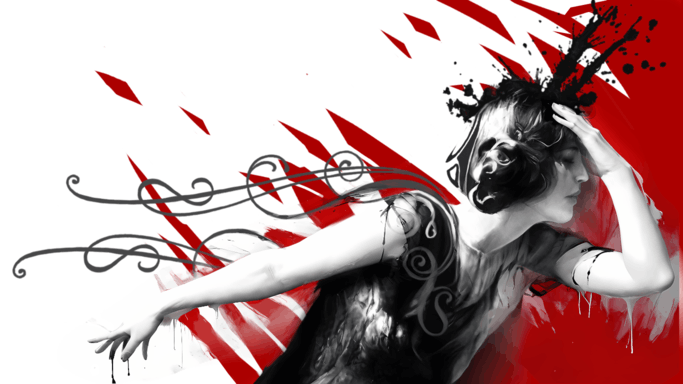
Here's the upcoming release. We're listing it at four because the pre-release material has been doing a lot of the talking, and because what it's attempting belongs squarely in this list's center of gravity rather than at its margins.
Maximilien is a French psychological horror interactive novel, hand-written by Yohan Dupuy and translated into English by Lucia Desogus, a literary translator working at a level you very rarely see in games. Set in 1920s Boston. You play a man whose grasp on what is memory, what is hallucination, and what is correspondence with someone who shouldn't be writing back is — coming undone. The shorthand reviewers keep returning to: if Disco Elysium had been set in 1920s Boston and written by Huysmans. That's a specific bar. The demo suggests it's met.
What sets the project apart, beyond the writing itself, is its production posture. Built in Twine/SugarCube — the same engine that gave us Howling Dogs and The Uncle Who Works for Nintendo — illustrated by Nicolas "Solynk" Thonney, scored by Gaëtan Larant. Multiple routes, multiple endings, branching deep enough to reward second and third reads. The translation is literary first and ludic second, which is most of why the English version reads like a published novel and not a localization.
Release: October 26, 2026, on Steam and itch.io. Windows and Linux at launch, English and French simultaneous. The in-character archive is already accepting letters from early readers — you can Join the Maximilien Experience to start receiving the first dispatches before the game ships.
Perfect for: readers of À rebours, fans of unreliable epistolary fiction, anyone who suspects the most genuinely literary work in games right now is happening in interactive fiction.
sunset visitor's 2024 debut, published by Fellow Traveller, won a Peabody Award — the first interactive game to do so for storytelling — and a stack of Game Developer Choice nominations besides. The premise is sci-fi: a thousand years after an alien plague, humanity is reduced to one immortal woman, the ALLMOTHER, and her seven sister-clones living in an underground orchard. You play Watcher. You dive into the ALLMOTHER's memories. The world above isn't what you've been told. Neither are the sisters.
The horror is generational. Memory becomes a haunted house. The script runs to twenty thousand lines, and the game's deepest concerns — how diaspora communities transmit trauma, how authoritarian families recreate themselves, how love survives institutional gaslighting — read as some of the most original genre work the medium has produced. Sunset visitor's team is majority Asian-Canadian, based in Vancouver, with backgrounds in dance, theatre, and performance art. It shows. The framing is unlike anything else in games.
Around ten hours. Cried-on-public-transport-recommending-it good.
Perfect for: NieR fans, readers of Ted Chiang and Ling Ma, anyone who's ever had a difficult conversation with their mother.
Wrong Organ's 2024 debut. The Tulpar is a Pony Express interplanetary cargo ship. Captain Curly has crashed it on purpose. You'll piece that together — eventually, in fragments, out of order — across a four-hour first-person horror game told in low-poly, fifth-console-generation aesthetics that critics have compared to David Lynch's framing and the corporate satire of Alien.
The game's structure is its weapon. Scenes from before and after the crash interleave. You see the consequence first, the cause later, the lie that bridges them last. By the time the timeline reassembles, the game has finished doing whatever it intended to do to you. Sales crossed 500,000 inside six months; a console release shipped in 2025. Some of the best writing the indie horror scene has produced this decade.
Content-warning for self-harm, sexual assault, and ambient corporate cruelty. The game does not flinch.
Perfect for: Annihilation readers, players who like their horror short and load-bearing, anyone fascinated by failure as a subject.
Geography of Robots' 2022 point-and-click follows Kay, returning to her flooded hometown of Norco, Louisiana, in the wake of her mother's death. Her brother is missing. There's a mass-produced android named Million, who is having something like a religious crisis. There's a Shield Oil refinery on the horizon, doing what oil refineries do. And there's the bayou, which is doing what the bayou does — eating the map.
The writing is what carries it. The pixel art is beautiful and intentionally compressed; the dialogue is closer to Barry Hannah and Denis Johnson than to most game scripts. Norco is southern gothic the way True Detective season one is southern gothic, but more interior, more fragmented, more interested in what oil capitalism does to family memory. Five hours. Tribeca Award winner. Quiet masterpiece.
Perfect for: readers of Jesmyn Ward and Cormac McCarthy, anyone who loved Kentucky Route Zero and wanted it more grief-stricken.
Obsidian Entertainment's 2022 narrative RPG, written and directed by Josh Sawyer, is set in the fictional Bavarian village of Tassing across two and a half decades in the early Reformation. You play Andreas Maler, a journeyman illustrator visiting the abbey of Kiersau. A murder happens. You investigate. So far, so genre. What makes Pentiment narrative horror — and we'd argue it is — is what the game does to you across its three acts: it makes you assign guilt, watch the wrong person be punished, and live with the consequences for years of in-game time.
The art style is illuminated manuscript. The dialogue letterforms shift to indicate class and education — illiterate characters speak in handwritten cursive that rewrites itself as they correct mistakes. It's one of the most stylistically distinctive games of the decade and one of the most thematically serious things ever shipped under a Microsoft umbrella. Twenty hours. Very few games are doing this kind of work.
Perfect for: Umberto Eco readers, medievalists, anyone who likes a mystery that refuses easy answers.
Black Tabby Games' first project, ongoing since 2021, is an ink-illustrated visual novel set in a dying Appalachian mining town. You arrive for your grandmother's funeral. Your estranged cousin Tabitha is the only family you have left, and the town's been keeping secrets — the kind that are written in geology, family Bibles, and the way nobody talks about the iron mine.
The choice system is what places it on this list. Two traits chosen at character creation — book smart, powerful build, keen eye, charming, street smart, magically inclined — open or close hundreds of branches. Genuinely. By Episode 3 you've stopped playing for the mystery and started playing because you've decided to protect Tabitha Bell or Stella Grey or Avery Shaw, and you'll do whatever the script asks. Currently four episodes deep of a planned seven, with episodes 5–7 in production. Free demo of episode 1 on Steam — start there.
Perfect for: Night in the Woods fans, Twin Peaks viewers, character-driven readers.
Team Salvato's 2017 freeware Doki Doki Literature Club got an expanded Plus! release in 2021, and there's a reason it shows up on every "games that actually scared me" list eight years later. The opening hour is a pastel high-school dating sim about a literature club. The remaining hours are not. Going further would spoil the trick. The trick is excellent.
Content-warning for severe mental-health themes is non-optional and front-loaded; do not give this game to teenagers without the warning. Plus! adds side stories and dev commentary that are genuinely worthwhile if you want to understand what the script is doing structurally. Among the most influential horror works of its decade — every "the game is haunting itself" indie since owes it.
Perfect for: visual novel newcomers, fans of meta horror, players who want to understand why an entire microgenre of indies exists.
SBN3's 2021 visual novel — followed by The Re-Up (2023) and The Flip Side (2024) — is the hardest entry on this list to pitch in a paragraph. Marketed as a "rejection sim" and an "interactive sitcom," the trilogy follows Nicole, a self-identified sociopathic high schooler in late-2000s suburban Virginia, across her junior and senior years, and then — in the third game — flips perspective to her best friend Jecka, with results most fans found genuinely upsetting.
The horror is satirical and unrelenting. Bullying, predation by adults in positions of trust, mass-shooting routes, suicide endings, the specific texture of Bush-era American teenage cruelty. Every line is fully voice-acted (Elsie Lovelock and Kayli Mills carry the cast). The franchise has sold over 250,000 copies on the strength of TikTok virality, and reads as one of the most uncompromising commercial works the medium currently allows. Hard to recommend lightly. Worth recommending honestly.
Perfect for: mature players who can handle satire that genuinely lands its punches. Mental-health content warnings apply heavily.
Cardboard Computer's 2013–2020 episodic adventure isn't usually shelved as horror, and it shouldn't be — but the work it's doing belongs in this conversation. Five acts, released over seven years, following Conway and a rotating cast of strangers along a fictional Kentucky underground highway in search of an address that doesn't quite exist. Inspired by Cormac McCarthy, Italo Calvino, the Federal Writers' Project, and Ohio Players album covers. Every act has a free downloadable interlude — short experimental texts that recontextualize what came before.
The dread builds slowly across the run. By Act V, the game is doing things with grief, debt, and the slow industrial death of communities that very few works of fiction in any medium attempt. The TV Edition collected the whole run in 2020. Twelve to fifteen hours total. A quiet, devastating, formally inventive piece of work.
Perfect for: patient readers, theatre fans, anyone who's been to a place that's already mostly gone.
Twelve games is a lot to start with. Here's a shorter way:
For your first narrative horror game ever: Doki Doki Literature Club Plus! or Slay the Princess. Both are short, both rewire what you expect from the genre.
If you're a literary fiction reader: Disco Elysium, Norco, or Pentiment. All three are operating at the level of contemporary novels.
For short and devastating: Mouthwashing (4 hours), Indika (4 hours), or Slay the Princess (10 hours).
If you want weird: Indika or Kentucky Route Zero — the most formally adventurous work on this list.
For a 2026 release worth wishlisting now: Maximilien, October 26. Hand-written, obsessively translated, set in 1920s Boston. You can read more about the project or sign up for in-character dispatches before launch.
If you're new to interactive fiction as a form, our guide to text-based horror games covers the form and its essential titles.
A narrative horror game is one where dread and unease come primarily from writing, character, and structure rather than monsters or jump scares. Choices, dialogue, and reading replace combat as the central mechanic. Examples include Slay the Princess, Disco Elysium, 1000xResist, and Mouthwashing.
Often more so. The horror comes from what characters say, what they hide, and what choices the game makes you make. A line of dialogue in Pentiment or a single image in Slay the Princess can do more than most jump-scare sequences. Monsters end. Sentences linger.
Visual novel describes a format — text-driven storytelling with static or limited animation, branching choices, and minimal mechanics. Narrative horror describes a tone and intent. Many narrative horror games are visual novels (Slay the Princess, Doki Doki Literature Club Plus!, Maximilien), but some aren't. Disco Elysium is an isometric RPG. Indika is a third-person adventure. Norco is a point-and-click. The format varies; the writing-as-mechanic does not.
Depends on what you read. If you read literary fiction: Disco Elysium. For short and devastating: Mouthwashing or Slay the Princess. If you've never played a visual novel: Doki Doki Literature Club Plus! or Scarlet Hollow. For something releasing in 2026: wishlist Maximilien for October 26.
Yes — better than most genres. They reward reading skills, attention, and willingness to sit with discomfort, not reflex or hardware fluency. Pentiment, Disco Elysium, Norco, and Maximilien have all converted readers and film viewers who don't otherwise play games.
Twelve games, written by twelve very different teams, doing something the rest of the medium often forgets it can do: sit you down, hand you a paragraph, and ruin a quiet afternoon. If you've never played a visual novel, Doki Doki Literature Club Plus! is free and complete in a sitting. If you read literary fiction, Disco Elysium is still the tallest mountain in the genre. Norco and Pentiment sit beside it as art objects more than products. Slay the Princess, 1000xResist, and Mouthwashing represent the strongest indie wave the form has had since the 2010s.
And if you want a book that hasn't been written yet — one set in 1920s Boston, hand-translated by a literary specialist, illustrated and scored by a small French team that has clearly been reading Huysmans — Maximilien opens on October 26, 2026. The archive is already accepting letters from early readers. Join the Maximilien Experience to receive the first dispatches before launch. We'll see you in Boston.
The Maximilien Archive is the editorial voice behind maximilien-game.com, maintained by the development and marketing team for Yohan Dupuy's forthcoming psychological horror interactive novel Maximilien. Coverage focuses on narrative horror, interactive fiction, and the craft of literary game design. All titles above were played or read by the editorial team; release dates and studio details verified as of May 2026.
Further reading on this site:
Coming October 26, 2026 on Steam
Windows · Linux
English · Français


Created by Yohan Dupuy© 2026 — All rights reserved