Reading time: 14 minutes
Every major horror writer of the twentieth century worked in text. Poe never had a rendering engine. Lovecraft never had a physics simulation. What they had were sentences, and the reader’s willingness to lend them a mind. That transaction — writer supplies the words, reader supplies the images — is older than horror itself, and it produces a specific kind of fear that no other medium can quite replicate.
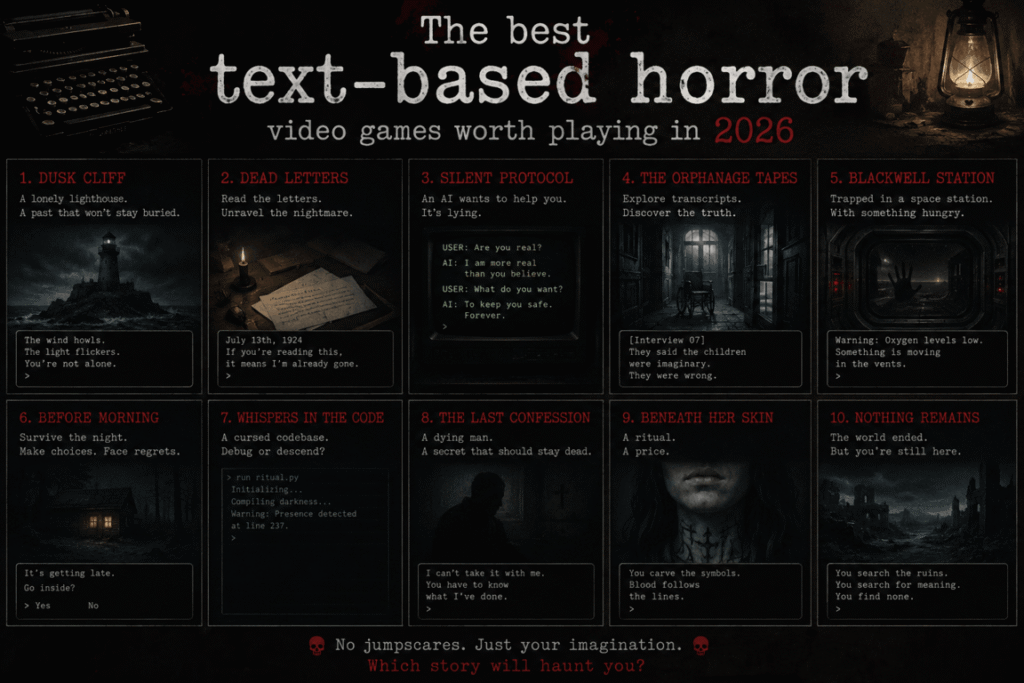
Video games have known this since their beginning. The earliest horror games were text adventures because text adventures were the only games there were. The medium is still alive today, in ways most players never see, and 2026 turns out to be a strong year for it. Below are eight text-based horror games worth loading — from a 1998 parser classic that still holds up, to a Twine work that changed the form, to World of Horror in its post-Early-Access maturity, to Maximilien, releasing on Steam on October 26, 2026.
Short version, if you want the direct path: for a classical Lovecraftian text adventure, start with Anchorhead. For horror that keeps evolving the medium, anything by Porpentine. For a modern psychological horror novel in the Poe tradition, Maximilien, releasing October 26.
There is a reason horror literature has always outperformed horror cinema in the memory. A film shows you the monster; a book makes you invent it. What your own imagination puts in the gap is, by definition, personally tailored to frighten you — because it is built from the specific things your mind is already afraid of, drawn from a lifetime of dreams and small childhood terrors you may not consciously remember.
A text-based game inherits that advantage. The prose describes; the reader constructs. The game does not need to render a rotting corpse for the horror to work — it needs only to name the smell in the right sentence, and every reader will produce their own personal version of the image, more disturbing than any pre-rendered asset could be. This is why House of Leaves is scarier than most horror films, and it is why the small, ongoing tradition of text-based horror games is worth paying attention to in 2026.
The second advantage of the format is structural freedom. A 3D horror game costs millions to make and requires a hundred people. A Twine or parser game can be authored by one person over a weekend, on a laptop, with no budget. That means text-based horror can go places larger productions cannot — it can be strange, angry, personal, experimental, or short enough to finish in one bad hour. It can be a poem. It can be dysphoric. It can refuse to be marketable. Several of the games below took that freedom and produced works that no thirty-person studio would have signed off on, and are the better for it.
The third, quieter advantage is trust. When you play a first-person horror game, you know the camera is not going to lie to you outside of scripted moments. When you read a text-based horror game, the text itself is the medium — and the medium can lie. Sentences can be wrong. Paragraphs can be missing. Words can distort in ways the character does not notice. That instability is unavailable to 3D horror by construction, and it is exactly where the most interesting text-based work has been happening for the last decade.
Michael Gentry’s parser interactive fiction from 1998 is the canonical entry point for anyone who has never played a text-based horror game. Set in the fictional coastal town of Anchorhead, Massachusetts, over a long weekend in the 1990s, it follows a woman who has inherited her husband’s family estate and begins, slowly, to understand what the family actually was. The debt to Lovecraft is total and openly acknowledged; the execution is better than most of what Lovecraft himself managed. Puzzle-driven, dense with description, and playable free online through modern parser interpreters, Anchorhead remains the best-argued case for the form to a newcomer. It has been quietly ported and updated for nearly three decades, and there is a reason.
Where to play: free on the Interactive Fiction Database (IFDB) and mirrored on multiple parser platforms.
Christine Love’s visual novel about a lost generation ship is text-based in the strictest sense that matters — the storytelling happens entirely through documents you read: emails, diaries, transcribed conversations from a colony that no longer exists. You are an investigator sent to retrieve those documents from an abandoned ship, and the horror emerges gradually as you understand what the crew did to each other over the centuries of the voyage. The two AI companions who help you decode the archive have their own agendas, and the game’s endings depend on which one you have chosen to trust by the final hour.
Analogue is the most conventional-looking entry on this list, and possibly the most emotionally devastating. Its sequel, Hate Plus, is worth playing immediately after.
Where to play: Steam, itch.io. Around $10.
Porpentine’s Twine work from 2012 is, along with Anchorhead, one of the two most influential text-based horror games of the last three decades — for entirely different reasons. Where Anchorhead extends a genre tradition, Howling Dogs broke a form open. The player is confined to a small grey room, cycling through the same restricted daily activities: eat nutrient bar, use the sanitation facility, look in the mirror, put on the virtual reality visor. The visor is where the game happens. Each session inside is a different fragment of prose, a different environment, a different reality — and the small grey room, waiting between sessions, becomes worse the longer the game continues.
Howling Dogs is not long. It is not comfortable. It is one of the pieces of interactive fiction that changed the perception of what the medium could carry, and it is available free.
Where to play: free in-browser at Porpentine’s page or the IFDB mirror.
Michael Lutz’s Twine piece takes a specific childhood horror — the sleepover at a friend’s house that lasts too long — and lets it slide, sentence by sentence, into something the child cannot name. It is short, roughly forty minutes on a first playthrough, and has multiple endings whose relationship to each other is worth working out. The title is a joke that stops being one about ten minutes in.
What The Uncle Who Works for Nintendo does that no other game on this list does is weaponise the specific texture of childhood memory — the ambient wrongness of adult behaviour a child cannot yet interpret. It is available free, and if you have not played it, you should.
Where to play: free in-browser at the IFDB.
Porpentine’s second entry on this list, this time co-authored with musician Brenda Neotenomie. With Those We Love Alive asks the player to keep a pen nearby before starting. At various points, the game asks the reader to draw on their own skin — sigils, marks, memorials — in response to what has just happened in the story. The prose is dense, poetic, and about serving a monstrous ruler in a court of scaled things.
The game refuses to explain itself and does not try to be conventional horror. What it is instead is one of the most complete uses of the reader-as-body that the medium has produced. Whether or not you actually draw on your skin when prompted is between you and the game.
Where to play: free in-browser.
The most mainstream game on this list, and the one most players have already heard of. Team Salvato’s free visual novel presents itself as a saccharine dating simulator set in a high school poetry club, and remains that thing for its first ninety minutes with such commitment that the pivot, when it comes, is a genuine shock. The horror of Doki Doki is meta-textual: it attacks the medium itself, corrupts its own save files, addresses the player rather than the character, and does things to the game’s structure that no first-person horror game can do.
It is on this list because, despite its sprite art, its horror lives in the text and in the reader’s relationship with the interface. The moment when the fourth wall bends is one of the most-copied ideas in horror games of the last decade. Free, available on Steam and itch.io, no barrier to entry beyond a Steam account.
Where to play: free on Steam and itch.io.
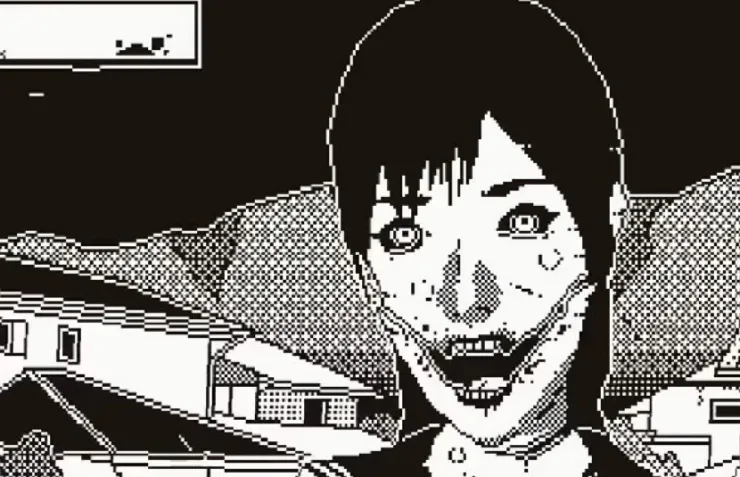
Paweł Koźmiński’s cult 1-bit horror roguelite left Early Access in October 2023 and is now the most polished entry point to text-based horror on Steam. Set in a fictional Japanese seaside town called Shiokawa in the vague late 1980s, the game presents itself as a series of typewritten mysteries you attempt to solve before the Old Gods return — with combat, sanity, resource management, and cosmic horror scenarios all rendered in monochrome pixel art drawn in MS Paint. Written contributions from Cassandra Khaw give the prose a professional edge that similar indie efforts rarely match.
The visual style is striking, but the game is fundamentally text-driven: mysteries are described, choices are read, and combat resolves through short written encounters. It is currently one of the highest-rated horror titles on Steam and one of the few text-based horror games with genuine mainstream reach.
Where to play: Steam, GOG, PlayStation, Switch. Around $20.
The newest entry, and the reason this article exists. Maximilien is a psychological horror interactive novel set in Boston in 1926, releasing on Steam on October 26, 2026. It follows a psychology student across four days of an investigation whose grip on itself, and on him, deteriorates as the reader progresses. Twelve possible endings and roughly 110,000 words of authored prose.
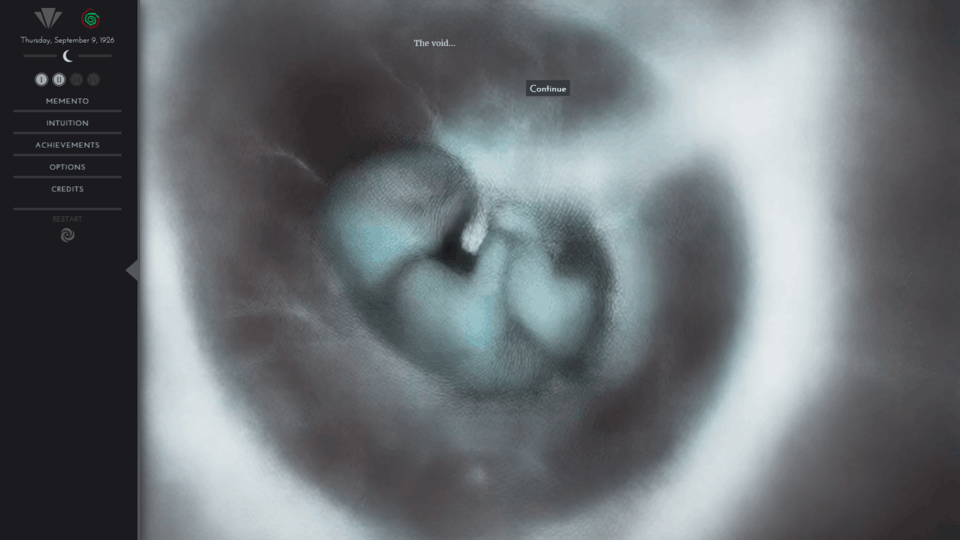
What separates Maximilien mechanically from the other games above is its mental-state system. The system does not generate new text or rewrite scenes — the prose remains fixed and authored — but as the protagonist’s mind frays, visual artifacts build up little by little and unsettle the page and the interface, in ways the reader notices and the character does not. The words themselves never move. The story you read is stable. What changes is your ability to trust the page.
For readers who came to text-based horror through Poe, Machen, and the older tradition, Maximilien is the entry designed for you. A free English demo is available before launch.
Where to play: Steam from October 26, 2026 (wishlist open now, demo available).
Text-based horror has had two main lineages since the format matured. One is the parser tradition — Anchorhead and its descendants — which sits closer to puzzle-driven adventure fiction and rewards patience with worldbuilding. The other is the Twine tradition — Porpentine, Lutz, and their many successors — which uses hypertext for lyrical, experimental, often short work that is closer to prose poetry than to conventional games.
Maximilien is aiming at a third position that neither lineage has quite occupied: a long-form, professionally-produced text-based horror novel that reads like literary fiction and is engineered like a game. The prose is dense in the tradition of Poe and Machen. The structure is authored — twelve endings, a fixed underlying narrative — rather than procedurally generated. The interface is polished to a commercial standard rather than the deliberately raw feel of most Twine work.
The mental-state system is the mechanical hinge that makes this ambition workable. In a purely written medium, an authored story cannot rely on jump scares or environmental horror to sustain dread across many hours. It needs an ongoing mechanical pressure that the reader feels as a physical property of the text. The slow corruption of the page and the interface provides that pressure. The reader watches the screen grow less trustworthy as the character becomes less reliable, and the sense of shared deterioration — reader and character together — is what text-based horror has always been reaching for and rarely delivered.
Whether Maximilien lands the ambition is a question the October 26 release will answer. What is already clear is that the game is trying to do something the older lineages had left open, and that the try is worth paying attention to.
If you want the canonical entry point: Anchorhead. Free, playable in a browser, and it still holds up.
If you want to see what the medium can really do: Howling Dogs or With Those We Love Alive. Neither is easy. Both are essential.
If you want the most-copied idea in horror games of the last decade: Doki Doki Literature Club!. Free. Trust nothing.
If you want the polished modern Steam entry: World of Horror. Weird, mean, and beautifully specific to its own aesthetic.
If you want the emotional wreckage option: Analogue: A Hate Story. Bring a whole evening and something to drink afterwards.
If you want the childhood-memory horror: The Uncle Who Works for Nintendo. Under an hour. You will not forget it.
If you want the newest release, built specifically for readers of literary horror: Maximilien, releasing October 26, 2026. A free English demo is available before launch.
A text-based horror game is a game where the primary medium of storytelling and gameplay is written text rather than 3D environments, sprite-based visuals, or cinematics. This includes parser interactive fiction (games like Anchorhead, where you type commands), hypertext works built in tools like Twine, text-heavy visual novels, and hybrid formats that combine text with minimal illustration. The common criterion is that reading, not watching or navigating, is the dominant activity.
Yes, actively. The interactive fiction community produces dozens of new text-based horror works every year, most of them free and playable in a browser. IFComp, the annual interactive fiction competition, includes several horror entries each year. Commercial releases are rarer but growing: World of Horror reached Steam mainstream success in 2023, and Maximilien releases in October 2026 as a fully commercial text-based horror novel.
The Interactive Fiction Database (IFDB) hosts thousands of playable text-based games, most of them free, playable in-browser or downloadable. Porpentine’s works, Michael Lutz’s Twine games, Anchorhead, and hundreds of others are available at no cost. Doki Doki Literature Club! is free on Steam and itch.io. Commercial titles like World of Horror and Analogue: A Hate Story are paid.
Yes. Maximilien is a psychological horror interactive novel where the storytelling is entirely text-based. It uses a mental-state system in which visual artifacts build up across the page and the interface as the protagonist’s mind frays, but the underlying story is written prose, not procedurally generated or rewritten. It releases on Steam on October 26, 2026.
The most defensible single answer is Anchorhead for its enduring quality, longevity, and canonical status. For influence on the modern form, Howling Dogs by Porpentine. For mainstream reach, Doki Doki Literature Club!. There is no consensus, and the honest answer is that the medium has produced enough distinct masterpieces that the “best” question is genuinely underdetermined.
Text-based horror survives because it is the oldest form of the genre and the most efficient. It requires no engine, no budget, no server. What it requires is a writer with something to say and a reader willing to lend their imagination for a few hours. Every game on this list earned its place by respecting that transaction — and by making the reader’s contribution more important than the developer’s. If you have never tried the format, Anchorhead and Doki Doki are both free and take one evening. If you already know the format, the newest release, in October, was built with you in mind.
Releasing October 26, 2026.