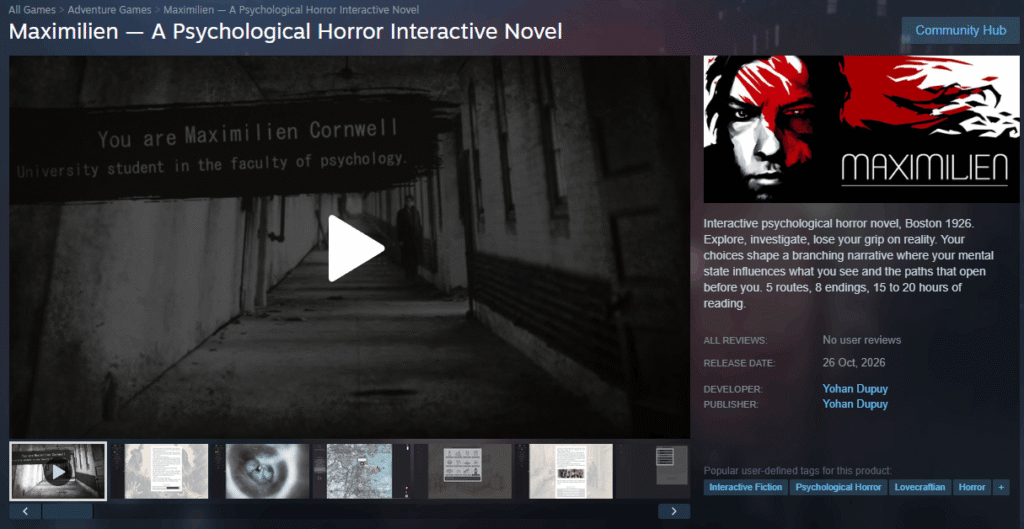
Halloween horror doesn’t always chase you down a corridor. Sometimes it hands you a magnifying glass, a stack of contradictory testimonies, and a corpse that won’t explain itself. If you’ve searched for murder mystery horror games this October, you’re probably tired of jump scares and looking for something that rewards patience instead of reflexes — games where the dread comes from understanding, not running. This list covers five of the genre’s sharpest entries, plus a new one: Maximilien, a psychological horror interactive novel launching on Steam on October 26, 2026, built entirely around a Boston psychology student piecing together a string of unsolved 1926 murders.
None of these games ask you to survive a monster. They ask you to survive an idea, and that’s a harder thing to shake off after the screen goes dark.
Chase horror works on adrenaline. Deduction horror works on dread that arrives late, after the pieces click into place and you realize what you’ve actually been looking at. There’s no monster to outrun, so your brain can’t discharge the fear through movement. It just sits there, accumulating, while you cross-reference a timestamp against a wound and understand, slowly, exactly how someone died.
That delay is the trick. A jump scare resolves in a second. A murder mystery lingers for hours, because the horror isn’t an event — it’s a conclusion you built yourself, testimony by testimony, out of evidence you can’t unsee. Halloween thrives on things that stay with you past midnight. Few horror mechanics stay longer than a puzzle your own mind solved.
Lucas Pope’s black-and-white deduction game drops you on a merchant ship whose entire crew has vanished — and then died, one by one, in scenes frozen in time by a strange pocket watch. You walk through each death, cataloging faces, accents, uniforms, and last words, until sixty names resolve into sixty specific fates. Nothing jumps out at you. The horror is cumulative, built from the sheer scale of a crew being erased and your slow, methodical reconstruction of how.
The 1-bit visual style should feel like a limitation. Instead it sharpens everything — every frozen tableau becomes a puzzle box with corpses in it, and the game trusts you completely to solve it without a single hint beyond your own notes.
Perfect for: players who want deduction with zero hand-holding and a genuinely brilliant “aha” mechanic.
Where Obra Dinn gives you a ship, Golden Idol gives you a series of frozen crime scenes spanning generations, each one a fresh puzzle of names, motives, and objects you have to infer from visual clues alone. There’s no dialogue tree, no hint system worth relying on — just a scene, a cast of suspicious faces, and your growing certainty about who did what to whom, and why.
The tone is macabre in a way that sneaks up on you. What starts as a single strange death unspools into a multi-generational conspiracy involving a cursed idol, and each chapter recontextualizes the ones before it. It’s deduction horror as slow-burn family saga.
Perfect for: fans of Obra Dinn who want a faster pace and a sprawling, twisted plot to match the puzzles.
Sam Barlow’s Her Story hands you a police database of interview footage and almost nothing else. You type search terms, watch fragments of a woman being questioned about her husband’s murder, and type more terms based on what you just heard. There’s no correct order. The horror builds entirely through your own curiosity, and through the growing, uncomfortable sense that the story you’re assembling might not be the one you think it is.
It’s a game about interrogation as much as it is about murder — about how a single person can tell the truth in pieces, and how those pieces reassemble into something you didn’t expect. The FMV format, dated on paper, turns out to be exactly what the mystery needs.
Perfect for: players who want a genuinely non-linear mystery and don’t mind building the narrative structure themselves.
Red Thread Games’ quieter entry trades crime-scene puzzles for atmosphere. Set in 1920s Norway, Draugen follows an American man searching a remote fishing village for his missing sister, accompanied by a companion whose optimism starts to feel more and more like denial. The investigation here is slower, sadder, and less about solving a single crime than about realizing, piece by piece, that the village itself is wrong.
It’s the closest thing on this list to a period-piece ghost story, and its 1920s setting makes it a natural companion to anything set in that same uneasy decade between the wars — a time period horror keeps returning to for a reason.
Perfect for: players who want investigation horror that leans into mood and heartbreak over hard puzzle logic.
No enemies. No jump scares. No combat of any kind. The Painscreek Killings drops you alone in an abandoned town and asks you to solve a decades-old unsolved murder using nothing but exploration, environmental clues, and old documents left behind by people who are all long gone. The horror is entirely atmospheric — an empty town at dusk, a case nobody closed, and the growing certainty that you’re the only person who ever will.
It’s the purest expression of the “detective, not survivor” horror formula: your only tools are your eyes and your notes, and the town rewards exactly the kind of close, patient reading that murder mystery fans already love.
Perfect for: players who want first-person investigation stripped down to pure exploration and deduction, with no combat to distract from the case.
Every game above earns its horror by making you the detective instead of the target. Maximilien, launching on Steam October 26, 2026, builds its entire structure around that same idea. You play a psychology student in 1926 Boston investigating a series of unsolved murders — following leads, weighing intuitions, and navigating a browsable map of the city as the case pulls you toward conclusions you’d rather not reach.
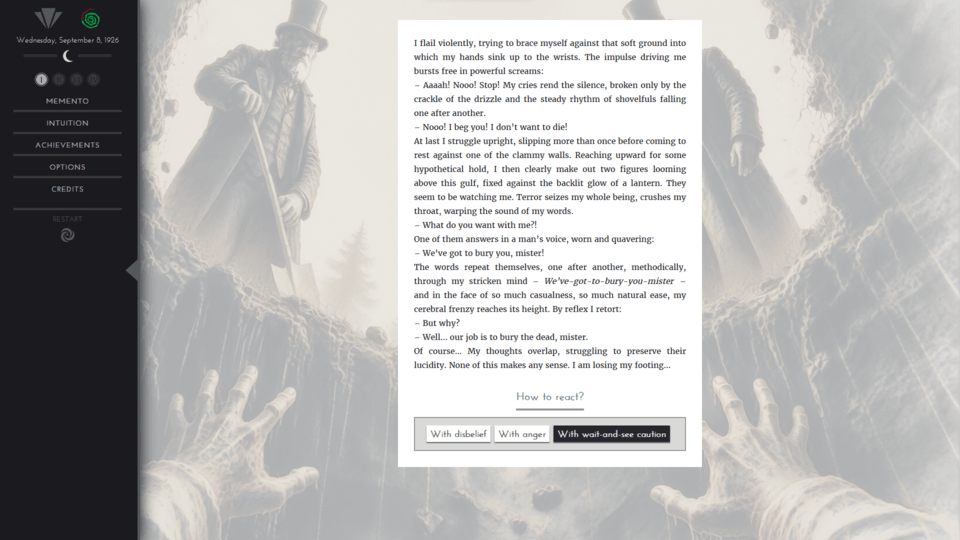
That’s the same DNA as Obra Dinn’s frozen tableaux or Her Story’s interview fragments: evidence you assemble yourself, at your own pace, toward a truth the game never simply hands you. Where Maximilien pushes further is in how it renders the toll that investigation takes. As your character’s grip loosens, visual artifacts build up and unsettle the page and the interface, but the prose itself never changes. You’re always reading the same true story. You’re just reading it through an increasingly unreliable window, the same way an unreliable witness in Her Story never lies about the facts, only about how they’re arranged.
The investigation branches toward twelve distinct endings, across roughly 110,000 words — enough narrative real estate for the same kind of slow-building dread that makes Draugen and Painscreek work. If detective horror set in an early-20th-century city is your thing already, Maximilien is worth a look among 1920s horror games, and it’s priced at $9.99 on Windows and Linux. You can wishlist Maximilien on Steam now, ahead of its October 26 release.
For a broader spread of this year’s Halloween lineup across every format, our full Halloween horror games guide covers survival horror, roguelikes, and more alongside these investigation-driven picks. If text-heavy horror specifically is what draws you in, our text-based Halloween horror games guide is a natural next stop.
What are the best murder mystery horror games? Return of the Obra Dinn, The Case of the Golden Idol, and Her Story are widely considered the genre’s high points, each built around reconstructing a crime from fragmented evidence rather than fighting through it. Draugen and The Painscreek Killings offer a slower, more atmospheric take on the same idea.
Are murder mystery horror games scary without jump scares? Yes. Most of the games on this list, including The Painscreek Killings and Draugen, contain no jump scares and no combat at all. The horror comes from atmosphere, isolation, and the discomfort of understanding exactly what happened to someone, piece by piece.
Is Maximilien a murder mystery game? Yes. Maximilien casts you as a psychology student investigating a series of unsolved murders in 1926 Boston, using clues, intuition, and a navigable city map. It launches on Steam on October 26, 2026, priced at $9.99 for Windows and Linux.
Does Maximilien’s mental-state system change the story? No. As your character’s mental state deteriorates, visual artifacts build up across the page and the interface, but the underlying prose never changes. You’re always reading the same story, just through a visually unstable lens.
What genre of horror is best for Halloween if I don’t like being chased? Investigation and deduction horror, exactly the games on this list, is built for players who want dread without pursuit. For a wider survey of Halloween-specific horror across every subgenre, see our psychological horror games pillar guide.
Detective horror asks something different of you than most Halloween games: patience, attention, and a willingness to sit with a conclusion you built yourself. Obra Dinn, Golden Idol, Her Story, Draugen, and The Painscreek Killings all prove the format can be just as unsettling as anything with a monster in it — sometimes more, because the horror doesn’t end when you close the game.
Maximilien joins that lineage this October, bringing a full investigation and twelve endings to a psychology student’s descent through 1926 Boston. Wishlist Maximilien on Steam ahead of its October 26 launch, and if you want details, teasers, and release-day updates in your inbox, join the Maximilien Experience.