Murder Mystery Horror Games to Play This Halloween
Murder Mystery Horror Games to Play This Halloween Halloween horror doesn’t always chase you down a corridor. Sometimes it hands...
Read More →
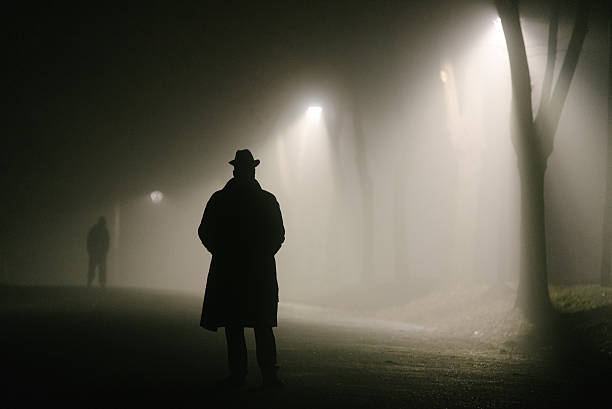
Published April 23, 2026 — Updated April 23, 2026 · 17-minute read
You don’t want jump scares. You want the floor to tilt under you — quietly, while you’re holding the controller, and for the tilt to still be there when you put the controller down. That’s the specific job psychological horror video games does, and it’s a different craft from survival horror, cosmic horror, or slasher pastiche. Below you’ll find eighteen games that do it well, ranked by how thoroughly they get inside your head and stay there. The list leans on decades of genre-defining releases (Silent Hill 2, Amnesia, SOMA), plus the remarkable wave of 2023–2025 indies that rewrote what the genre could sound like, look like, and read like. We’ve also flagged one upcoming 2026 release — a French interactive novel called Maximilien — that belongs in the conversation on merit, not hype. Expect dense atmospheres, unreliable narrators, and at least three endings you’ll refuse to talk about at parties.
Quick answer: The best psychological horror games in 2026 blend unreliable narration, oppressive atmosphere, and moral ambiguity over gore. Top picks include Silent Hill 2 (remake), Signalis, SOMA, Disco Elysium, Slay the Princess — The Pristine Cut, and Mouthwashing. For newcomers, start with Layers of Fear or Scarlet Hollow. For 2026 releases, keep an eye on Maximilien, a hand-written interactive novel set in 1920s Boston, due October 26.
Before the list, a quick filter — because “psychological horror” gets slapped on anything with a shadowy basement. The genre isn’t about what’s chasing you. It’s about what’s wrong with you for being there. Three markers tend to separate the real thing from genre cosplay:
With that in mind, here’s the list. Roughly ranked — but rankings in this genre are a courtesy, not a verdict.
Bloober Team’s remake was one of the most nervous releases of the decade. How do you touch Silent Hill 2? The answer, to nearly everyone’s surprise, was: carefully, and with reverence. James Sunderland still receives a letter from his dead wife. He still walks into the fog. Pyramid Head still exists as a punishment James can’t name.
What the remake adds is room — literal room. The combat is no longer a nuisance on the way to the writing; it’s part of the texture. The fog looks thicker on modern hardware, which matters more than it should. And Angela’s cutscene hits exactly as hard as it did in 2001, because they knew better than to rewrite it.
If you’ve never played any Silent Hill, start here. If you have, brace yourself; the remake doesn’t soften anything.
Perfect for: players who want the canonical psychological horror experience in a contemporary shell.
Yes, it’s on a psychological horror list. Fight me.
Disco Elysium is a role-playing game about a broken detective investigating a hanged man in the ruins of a failed revolution — but describe it that way and you’ve already lost what makes it terrifying. The horror is internal. Your skills are twenty-four voices in your head, and they argue. Empathy weeps. Logic calculates. Electrochemistry begs for one more drink. Inland Empire whispers that the tie on the fan is trying to tell you something.
ZA/UM built one of the densest, most literarily ambitious texts in the medium, and it happens to be funnier than almost any game ever made, which somehow makes the dread worse. Volition reminds you that you have been here before. Sooner or later, you remember why.
Perfect for: readers. People who like Dostoevsky, Hauntology, and being gently destroyed by a text parser.
rose-engine’s 2022 debut Signalis looks, on first glance, like a tight survival horror throwback. Top-down camera. Tank controls as a design choice. Inventory management that hurts. You’re a Replika — an android — waking on a derelict facility on a frozen moon, searching for someone you were made to find.
Then the static hits. Chapters start fragmenting. Somewhere around the midpoint you realize the game is about cycles, eternal return, devotional longing, and the specific horror of being built for someone who can’t love you back. Elster’s story is Silent Hill by way of Evangelion by way of Solaris, and the multiple endings are among the most devastating in the medium.
One of the finest psychological horror games of the 2020s, full stop.
Perfect for: fans of Silent Hill 2, NieR, and ambient dread.
Frictional Games followed up Amnesia with a game that swaps ghosts and gothic memory for a bathyscaphe at the bottom of the Atlantic, and somehow made it more terrifying. SOMA is less interested in scaring you than in asking you what you are.
Simon wakes up in 2104. Something has happened. The station, Pathos-II, is quiet. The machines talk. Some of them are people. Some of them think they are people. And you, the player, are going to have to decide — repeatedly — whether continuity of consciousness survives a transfer, a copy, a shutdown.
There’s a famous “safe mode” that disables the monsters so you can focus on the writing. That it exists, and that it works, tells you everything about what the game is really doing. A key reference point for any discussion of modern psychological horror games built around philosophical unease.
Perfect for: Black Mirror viewers, Ted Chiang readers, anyone who asks “but what is the ship of Theseus, really.”
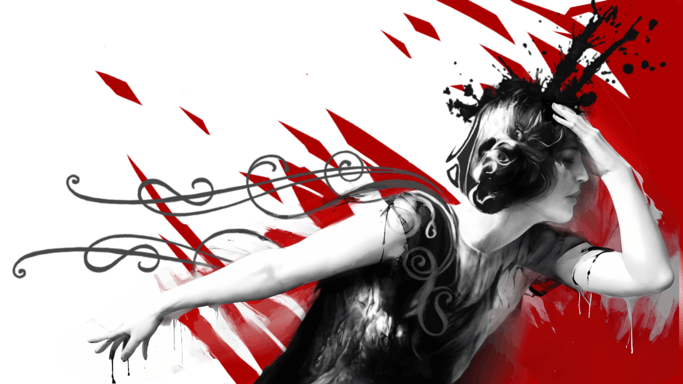
Here’s the one that isn’t out yet. We’re including it because it’s built on principles the rest of this list shares, and because the pre-release material is unusually strong.
Maximilien is a French psychological horror interactive novel, hand-written by Yohan Dupuy and translated into English by Lucia Desogus, a literary translator working at a level you very rarely see in games. It’s set in 1920s Boston. You play a man whose grip on what is memory, what is hallucination, and what is correspondence with someone who should not be writing back is — loosening. The closest shorthand reviewers keep reaching for: if Disco Elysium and Signalis had a child in 1920s Boston. That comparison sets a bar. The demo suggests the bar is met.
Built in Twine/SugarCube, illustrated by Nicolas “Solynk” Thonney, scored by Gaëtan Larant. Release: October 26, 2026, on Steam and itch.io. The archive is already open for those who want to get in early — you can Join the Maximilien Experience to receive the first in-character dispatches.
For more on the format, see our guides to text-based horror games and 1920s horror games.
Perfect for: readers who want a book that can look back at them.
Thomas Grip and Jens Nilsson’s 2010 indie gave modern horror a grammar: no combat, a sanity meter, a flickering lantern, and an enemy you survive by not looking at. It’s hard now to appreciate how radical that was. For most of the 2000s, horror had drifted into action. Amnesia dragged it back into a wet stone corridor and whispered, hide in the closet.
The atmosphere has aged a little. The design philosophy hasn’t aged a day. Every walking-simulator, every Let’s Play that built its view count on screamed reactions, every “don’t look at the monster” mechanic of the 2010s traces a line back to here.
Perfect for: first-timers to the genre who want to understand the vocabulary.
Black Tabby Games’ 2023 visual novel is shorter than most entries on this list, and more replayable than most games, period. You’re on a path in the woods. At the end of the path is a cabin. In the basement of the cabin is a Princess. A voice in your head — the Narrator, voiced with theatrical menace by Jonathan Sims — insists you’re there to kill her. She insists otherwise. Nichole Goodnight voices every version of her. There are many versions.
The 2024 Pristine Cut added three new chapters, a new ending, and roughly 35% more content. It’s a horror-tragicomedy about the stories we inherit, the stories we tell ourselves about the people we love, and what it costs to stop slaying and start listening. Hand-penciled, fully voiced, under ten hours, and it will follow you around for months.
Perfect for: visual novel readers, philosophy undergrads, anyone who loved The Stanley Parable and wanted it to hurt more.
Red Barrels’ 2017 sequel divides people more than the original. Outlast 2 drops you, a documentary journalist named Blake Langermann, into the Sonoran Desert and a cult that has splintered into factions, each convinced the end is tonight. Blake’s only tools are a camcorder with a dying battery and his legs.
What makes it psychological rather than merely exhausting is the way the game flickers. The schoolhouse sequences — Blake’s childhood memories, intruding — are some of the most unsettling content ever shipped in a commercial game, precisely because they don’t announce themselves. You’ll be running from a cult leader with a pickaxe, then you’re fourteen, and a bell is ringing, and nothing about that is okay.
Content warning for this one is not optional. Read it before purchase.
Perfect for: seasoned players who can handle a very dark treatment of abuse, cults, and religious trauma.
Bloober Team’s original Layers of Fear (2016) was a first-person walking simulator about a painter going to pieces. The 2023 release remakes and combines the first game, its sequel, and DLCs into a single layered narrative — with an Unreal Engine 5 glow-up and, crucially, a new framing story (“The Writer”) that ties the whole anthology together.
It remains one of the purest exercises in environmental horror storytelling. Turn around in a corridor and the corridor has become different. A painting has aged. A door that was closed is open and wrong. Nothing chases you. Nothing needs to.
Perfect for: newcomers. The 2023 version is the best way in, and a natural bridge to the genre’s denser entries.
After Kojima and del Toro’s P.T. was pulled from the PlayStation Store in 2015, an entire micro-genre of indie horror spent a decade trying to recreate its specific dread. SadSquare Studio’s Visage got the closest. You wander a large suburban house in which terrible things have happened to the people who lived there, across three overlapping chapters. Mirrors matter. Lights matter. Pills matter.
It’s slow. The game expects patience, and rewards it with one of the most atmospherically oppressive single-location experiences in the genre.
Perfect for: the P.T. faithful, and anyone who wants to know what happens when a haunted house stops pretending to have a plot and just haunts.
LKA’s 2022 release is the hardest game on this list to talk about without warning. Set in a Tuscan lakeside estate in the final year of the Second World War, Martha Is Dead follows Giulia, whose twin sister Martha has drowned. The game moves through photography — you develop pictures as a mechanic — and folklore, specifically the White Lady of Italian superstition, and the line between the two frays.
Certain scenes were censored on console release, which gives you a sense of how committed the game is to not looking away from bodily horror and sustained grief. It is gorgeously written and performed in Italian (with excellent English subtitles and localization), and it is emphatically not for everyone.
Perfect for: mature players who can sit with historical trauma, unreliable memory, and a very specific European folk-horror register.
Wrong Organ’s 2024 debut is a first-person horror game about the crew of an interplanetary freighter called the Tulpar after a crash that was probably not an accident. Resources run out. Paranoia doesn’t. Told in a low-poly, fifth-console-generation visual register that critics have compared to David Lynch’s cinematic framing and the corporate-satire horror of Alien, Mouthwashing is under five hours long and hits like a much longer game.
The nonlinear structure — scenes from before and after the crash, interleaved — is the whole trick. You’re not discovering what happened so much as assembling the version of what happened that you can live with. You won’t be able to.
Perfect for: players who prefer their horror short, literary, and built around human failure rather than external threat.
Black Tabby Games’ first project, released episodically on Steam starting in 2021, is an ink-illustrated visual novel set in a dying Appalachian mining town where your estranged cousin has summoned you to your grandmother’s funeral. Choices matter to a degree most games only claim to. Traits you pick at character creation — “book smart,” “powerful build,” “keen eye” — actually open or close entire story branches, conversations, and in some cases character fates.
By Episode 3 you stop playing for the mystery (though the mystery is excellent) and start playing because you’ve decided to protect Tabitha Bell or Stella Grey or Avery Shaw, and you’ll do whatever the game asks. The horror is slow-burn folk-Southern-Gothic, and it sinks its hooks by being genuinely about the people.
If Slay the Princess introduced you to Black Tabby, this is where you find out they’ve been this good the whole time.
Perfect for: character-driven readers. Anyone who wept at Night in the Woods.
Ice-Pick Lodge’s Russian cult classic is technically the second take on a 2005 original, and it is more correctly thought of as a theater piece that happens to be distributed as a video game. You are the Haruspex. A plague has broken out in a town whose geography doesn’t quite obey geometry. You have twelve in-game days to do… something. Probably less.
Hunger, exhaustion, thirst, infection. The cast speaks in a register pitched somewhere between Brecht and folk tale. You will fail your first run. The game assumes you will. It is, among other things, about failure as a human condition.
Pathologic 2 is not a game you recommend lightly. It is the game you recommend when someone has played everything else on this list and asks, with some exhaustion, what’s left.
Perfect for: the brave. The theatrically minded. Those who want their horror to make demands.
Bloober again — they had a decade — with a cyberpunk psychological thriller in which you’re a Kraków detective in 2084 who can jack into the minds of the recently dead. Rutger Hauer voiced the protagonist in what turned out to be one of his final performances, and the weight he carries into every line is most of why the game lands.
The memory-dive sequences are pure psychological horror, because the minds you’re in are dying, fractured, or lying. The System Redux 2020 re-release adds content and a UE4 overhaul; it’s the version to play.
Perfect for: Blade Runner fans, cyberpunk readers, noir apologists.
Harvester Games’ point-and-click adventure begins with its protagonist’s suicide. That’s not a spoiler — it’s the opening scene. Susan Ashworth then meets an entity who sends her back to finish something, and the game that follows is a frank, compassionate, and deeply unsettling treatment of depression, trauma, and the possibility that other people might, occasionally, be worth staying for.
The art — a hand-drawn palette of black, red, and sickly yellow — is unmistakable. The writing is doing things most games never attempt. Mental-health content warnings apply heavily.
Perfect for: players who want a genre-defining indie most lists skip. Handle with care.
A 2012 free Half-Life mod that grew into a standalone game, Cry of Fear is rough around every edge and has haunted more teenagers than any psychiatric textbook. You’re a Swedish man lost in a city that isn’t Stockholm anymore. Something is eating the edges of the map. The monsters, tellingly, wear your face.
It’s the kind of project a big studio wouldn’t have the stomach to make. That’s why it works. It deserves a place on the list for what it did with nothing, and for how long its influence has lingered in indie horror.
Perfect for: indie-horror historians, Source-engine nostalgists, the patient.
Rayll’s ongoing anthology takes short, first-person, pixel-styled episodes based (loosely) on submitted real-world anecdotes: a late-night shift at a gas station, a house-sitting job, a road trip that went sideways. Each episode is sixty to ninety minutes. Nothing supernatural happens. Almost nothing happens at all, until it does.
The reason it works is restraint. No chase sequences, minimal mechanics, just the texture of a very bad night you’ve half-had yourself. A perfect palate cleanser between the heavier entries on this list, and some of the best proof that psychological horror doesn’t need a budget.
Perfect for: anyone who’s ever been the only car in a parking lot at 2 a.m.
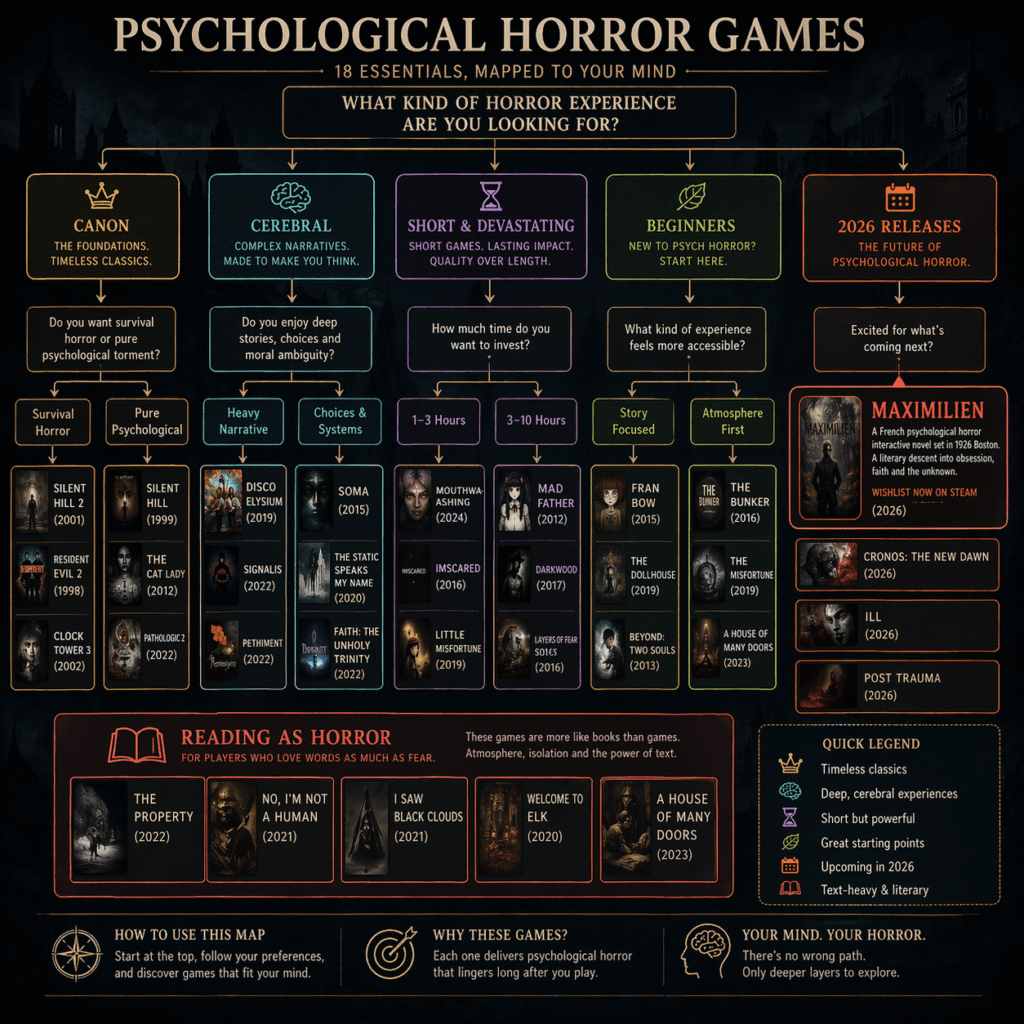
Eighteen games is a lot. Here’s a shorter way to decide:
If you want the foundational canon: Silent Hill 2, Amnesia, SOMA.
For cerebral and literary play: Disco Elysium, Signalis, Pathologic 2.
If you want short and devastating: Mouthwashing, Slay the Princess, Fears to Fathom.
Newcomers to the genre should try Layers of Fear (2023), Amnesia, or Scarlet Hollow first.
If you want something releasing in 2026: Maximilien, October 26. Everything else on this list shaped what it’s trying to do.
Finally, for horror specifically about reading as horror — the act of it, the unreliability of it, the claustrophobia of words on a page that know you’re there — that’s where interactive novels earn their place, and where a growing number of the most interesting psychological horror games are landing.
Survival horror is about managing resources under threat — ammunition, health, inventory space. Psychological horror is about managing your own certainty. The two overlap (Silent Hill 2 is both), but the center of gravity differs. If the game still scares you once the monsters are gone, it’s psychological.
Yes, quite a few. Disco Elysium has violence but treats it as narrative failure. The Cat Lady, Fears to Fathom, Scarlet Hollow, and Maximilien minimize or avoid combat entirely. Interactive novels and walking-simulator-adjacent games have carried the torch for non-violent horror since the early 2010s — see also our guide to horror games with a sanity mechanic.
Disco Elysium if they read literary fiction. Scarlet Hollow or Slay the Princess if they read graphic novels — or the best gamebooks for adults if they prefer print-style interactive fiction. Layers of Fear if they watch horror film. Maximilien when it releases in October, if they’re specifically drawn to historical and epistolary fiction.
Unusually good. Mouthwashing, Silent Hill 2 Remake, and Slay the Princess — The Pristine Cut all landed in a 14-month window, and the indie pipeline — rose-engine, Black Tabby, Wrong Organ, LKA — has rarely looked healthier. 2026 looks stronger still; Maximilien is one of several narrative-driven releases on watchlists.
No. Silent Hill 2 is self-contained and generally considered the best entry point. The other mainline games share atmosphere and locale but stand alone.
Start with Silent Hill 2 (2024 Remake), SOMA and Signalis for the classics, then Mouthwashing, Slay the Princess and Disco Elysium if you want stories that get under your skin without relying on jump scares. For something text-driven, Maximilien (Steam, October 26, 2026) turns the narrator’s mental state into the reading itself.
This guide ranks 18 titles, balancing recent releases and modern remakes: Silent Hill 2 (2024 Remake), Mouthwashing, Slay the Princess: The Pristine Cut and Fears to Fathom stand out, with Maximilien as the upcoming text-based entry on October 26, 2026. The full ranking above explains what each one does best.
Eighteen games, one short list, no wrong choices. Readers wanting the genre’s canonical experience should start with Silent Hill 2 (2024). If you want to understand what indies have done to the form in the past three years, play Signalis and Mouthwashing back to back and take the rest of the evening off. For those who want to be gently unmade by a novel, Disco Elysium is still the tallest mountain, and Scarlet Hollow the most generous companion.
And if you want something that hasn’t happened yet — something hand-written, obsessively translated, set in a city of rain and correspondence and unreliable narrators — Maximilien opens on October 26, 2026. The archive is already accepting letters from readers who want in before the first chapter is released. Join the Maximilien Experience to be among the first to receive the dispatches. We’ll see you in Boston.
The Maximilien Archive is the editorial voice behind maximilien-game.com, maintained by the development and marketing team for Yohan Dupuy’s forthcoming psychological horror interactive novel Maximilien. Coverage focuses on narrative horror, interactive fiction, and the craft of literary game design. All titles above were played or read by the editorial team; release dates verified as of April 2026.
Coming October 26, 2026 on Steam
Windows · Linux
English · Français


Created by Yohan Dupuy© 2026 — All rights reserved
Postal Telegraph · Boston Mass.
Development notes, latest news, exclusive updates.
Nothing else done with your address.
By subscribing you agree to receive news about Maximilien. See the privacy policy.