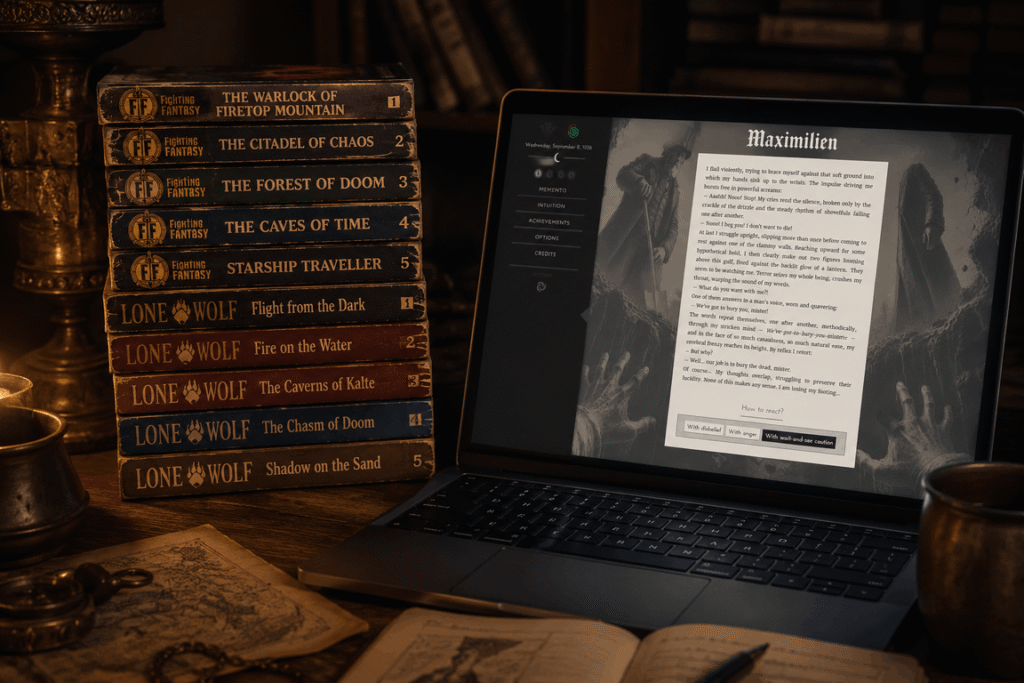
Somewhere between a novel and a board game sits a format publishing keeps almost forgetting about and readers keep rediscovering: the gamebook. You don’t read it start to finish. You read a passage, make a choice, jump to a number, and build a story that no other reader — including the version of you who plays it twice — will experience the same way. It was never really a children’s format. It just spent thirty years being marketed like one.
This guide covers eight best gamebooks for adults and gamebook-adjacent works that hold up for an adult reader in 2026, from the series that started the format to the interactive fiction that’s now carrying it into horror. It also does something most gamebook lists skip: it looks at what you actually get for your money — word count, replay depth, price — because a genre built on choice deserves an honest accounting of what each choice costs you.
A direct answer first, since it’s the question underneath this whole list: a good adult gamebook needs three things a children’s one can skip. Consequences that feel earned rather than arbitrary. Prose good enough to survive being read in fragments instead of sequence. And enough branching that a second read teaches you something the first one hid on purpose.
Strip any of those out and you get a gimmick — a choice mechanic bolted onto flat writing, or a maze of numbered paragraphs with nothing at stake. The eight entries below all pass that test, in different ways, across four decades.
Steve Jackson and Ian Livingstone’s 1982 debut is the reason “gamebook” is a recognizable word at all. You’re a lone adventurer, a dungeon, a set of dice, and roughly 400 numbered sections standing between you and a treasure hoard guarded by a warlock who is exactly as dangerous as the title promises. The prose is lean pulp fantasy, but the design underneath it — stat blocks, combat rolls, an inventory that actually matters — is what turned a paperback into something closer to a solo tabletop session.
The series ran to dozens of entries across the eighties and nineties and sold in the millions worldwide, enough to spawn a genre-defining imitation wave. It’s still the fastest on-ramp for an adult who wants to know what a gamebook feels like before committing to something longer.
Where Fighting Fantasy gave you a dungeon, Joe Dever’s Lone Wolf (1984–1998) gave you a continent, a war, and a single protagonist whose journey actually continues across all 28 books. It’s the gamebook series that took the format seriously as long-form fiction — carrying over your character’s skills, equipment, and choices from one volume into the next, decades before “save file” was a phrase readers used about print.
The practical reason it belongs on this list ahead of most competitors: Project Aon has made the entire series free to read online, with Dever’s blessing, as ebooks and companion apps. There’s no gamebook on this list with a lower barrier to entry relative to what you get in return.
The original Choose Your Own Adventure line (Edward Packard and R. A. Montgomery, from 1979) was aimed squarely at young readers, and most of it reads that way now. House of Danger (1982) is the exception worth knowing about: a murder-mystery gamebook set in a sinister mansion, with more of the “something is wrong here and it’s getting worse” tone that horror readers actually want, dressed in the same second-person structure that made the series a phenomenon.
It’s a useful reminder that the gamebook format was flirting with horror from nearly its first decade — it just didn’t have the freedom, or the intended audience, to go all the way there.
Joe Dever and Oliver Johnson’s Blood Sword (1987–1989) is the gamebook world’s closest thing to a cult classic aimed deliberately at older readers. Five books, a genuinely dark fantasy-horror plot involving a demon prince and the four Verthandi heroes assembled to stop him, and combat and puzzle systems dense enough that fan communities are still writing companion tools for it decades later.
It’s harder to find than Fighting Fantasy or Lone Wolf — most copies now circulate secondhand — but it’s the clearest evidence that the eighties gamebook boom already knew adult readers wanted higher stakes and darker prose. It just never fully broke into the mainstream the way its lighter cousins did.
Dave Morris and Jamie Thomson’s Fabled Lands (1995–1998) is the format’s most ambitious structural experiment: six interconnected books forming a single explorable world, with no fixed critical path. You can sail to a different book entirely mid-adventure, run a trading business, or simply wander — a design so far ahead of its era that later print runs and a digital revival both leaned on the phrase “gamebook RPG” to describe it.
For an adult reader who finds the tight, funnel-shaped structure of most gamebooks limiting, Fabled Lands is the answer: less a puzzle with one correct route, more a sandbox you happen to be reading.
Steve Jackson’s four-part Sorcery! (1983–1985) already stood out from standard Fighting Fantasy fare with a genuinely open map and a spellcasting system built from memorized word combinations. What makes it relevant to a 2026 list is what happened after: inkle’s digital adaptations (2013–2016) proved a gamebook could move to a phone screen and gain new tools — an undo button, a persistent map, an actual spellbook you build — without losing what made the format work on paper. It’s the clearest bridge on this list between the print era and where interactive fiction is going next.
Meg Jayanth and inkle’s 80 Days (2014), a steampunk reimagining of Around the World in Eighty Days, is not a horror pick, but it belongs on any serious gamebook list because of what it demonstrated commercially: that a choice-driven, prose-dense interactive novel could win major awards, sell broadly, and be discussed as literature rather than as a curiosity. It raised the ceiling for what publishers and players expected an adult gamebook to deliver, and every text-driven narrative game released since — Maximilien included — is working in the room 80 Days helped build.
Failbetter Games’ Fallen London (2009–ongoing) and Sunless Sea deserve a place here for readers who want the gamebook format pushed toward horror specifically: a “storylet” system where accumulating Nightmares changes what the prose will even let you attempt. It’s covered in more depth in our guide to horror games with a sanity mechanic — worth a detour if this is the thread you’re pulling on.
Gamebook fans rarely talk price-per-word, but it’s the most honest way to compare a genre where page count varies wildly and “length” doesn’t mean what it means in a normal novel. Classic Fighting Fantasy and Choose Your Own Adventure entries run short by design — dense with branching, light on prose per passage, built for a single afternoon. Lone Wolf and Blood Sword run longer and more novelistic. Modern digital gamebooks close the gap further by adding hours of replay value the original print format never budgeted for.
That’s the gap Maximilien is built to sit inside. It’s a psychological horror interactive novel — twelve endings and roughly 110,000 words of authored prose, releasing on Steam October 26, 2026 at $9.99. Measured against what a reader typically pays per hour of branching fiction in this genre, that’s a meaningfully larger amount of prose per dollar than most of the print series above offered even at their eighties cover prices, before you adjust for inflation.
The honest caveat: word count isn’t the whole story. A Fighting Fantasy book’s combat system and a Lone Wolf character sheet carrying over between volumes are doing something a purely textual novel doesn’t attempt. What Maximilien trades for that is a mental-state system that layers visual artifacts over the page and the interface as your character’s grip loosens, while the words themselves never change — the same lineage of trick Eternal Darkness pioneered in 3D, translated to the page.
This is for readers who liked the idea of Choose Your Own Adventure as kids and never found the adult version of it — or who did, and want to know what’s happened to the format since. It’s not for readers who want a conventional novel with no structural gimmick, or players expecting the pacing of a AAA video game; gamebooks, digital or print, ask you to slow down and read the sentence in front of you.
If you want the fastest possible taste of the format: The Warlock of Firetop Mountain. An afternoon, a pencil, a character sheet, done.
If you want the whole thing for free: Lone Wolf, through Project Aon. Twenty-eight books, no cost, one continuous story.
If you want the darkest print entry on this list: Blood Sword, secondhand copies only, patience required.
If you want a world instead of a corridor: Fabled Lands. No fixed route, no wrong direction.
If you want to see the format’s ceiling as literary fiction: 80 Days. Not horror, but essential context for everything after it.
If you want the newest attempt to drag the gamebook fully into horror: Maximilien, releasing October 26, 2026. A free English demo is available before launch.
A gamebook is a work of fiction structured as numbered passages or sections, where the reader makes choices at key points that determine which passage they read next. Some, like Fighting Fantasy, add dice-based combat and stats; others, like Choose Your Own Adventure, are purely narrative branches.
The terms overlap heavily. “Gamebook” usually refers to the print tradition — numbered sections, physical page-flipping — while “interactive fiction” more often describes digital or parser-based works, including Twine games and text adventures. Modern releases like Maximilien sit deliberately across both traditions: a numbered-choice structure inherited from print gamebooks, delivered through the software conventions of interactive fiction.
No, though the format’s biggest commercial wave — original Choose Your Own Adventure and most of Fighting Fantasy — was marketed at young readers. Series like Lone Wolf, Blood Sword, and Fabled Lands were written with older readers in mind from the start, and the modern digital wave, from Sorcery! to 80 Days to horror-focused releases like Maximilien, is built explicitly for an adult audience.
Project Aon hosts the entire Lone Wolf series as free ebooks with author Joe Dever’s blessing, along with fan-built companion apps for tracking character stats and inventory across the series.
Yes, in lineage if not in packaging. Maximilien is a psychological horror interactive novel — twelve endings and roughly 110,000 words, built in the choice-and-consequence tradition gamebooks established, but delivered as a $9.99 Steam release with a mental-state system in which visual artifacts build up across the page and the interface as the protagonist’s mind frays. It releases October 26, 2026.
The gamebook never actually went away — it just moved between formats every decade or so, from cheap paperback to CD-ROM experiments to Twine to phone app, always looking for the version of itself that could carry more story per choice. The eight entries above are the ones that made the format matter each time it resurfaced. Where it resurfaces next, for horror readers specifically, is worth watching this October.
Wishlist Maximilien on Steam — releasing October 26, 2026.