Reading time: 13 minutes
Most horror games threaten you from the outside. Something is in the dark, behind the door, in the next room — and your job is to outlast it. The best ones add a second front: they threaten you from the inside. The monster you can’t outrun is your own mind, and the game stops being a contest between you and what the developers built. It becomes a contest between you and your own composure.
That second front has a name in game design: the sanity mechanic. It first appeared meaningfully in 2002, has been refined across a handful of cult titles since, and in 2026 is about to take a new shape in Maximilien, a psychological horror novel set in Boston in 1926. This guide walks through six games that defined the mechanic, explains why it works when it works, and looks at where it goes next.
If you only want the short version: the horror games with a sanity mechanic shows a separate stat that tracks your character’s grip on reality, and the best implementations let that stat change what the player sees — not just what the character does. The next sections explain the rest.
A sanity mechanic is a quantifiable measure of a character’s mental state that affects how the game is played, perceived, or rendered. It usually sits alongside health and stamina as a third resource — but unlike health, it cannot be replenished by a medkit, and unlike stamina, it does not recover by waiting. It deteriorates through exposure: to violence, to the supernatural, to specific environments, or simply to time spent in proximity to the wrong things.
Three ingredients separate a memorable sanity mechanic from a forgettable one:
These three criteria explain why the six games below are remembered as masterclasses of the form, and why dozens of others that included a “sanity bar” are not.
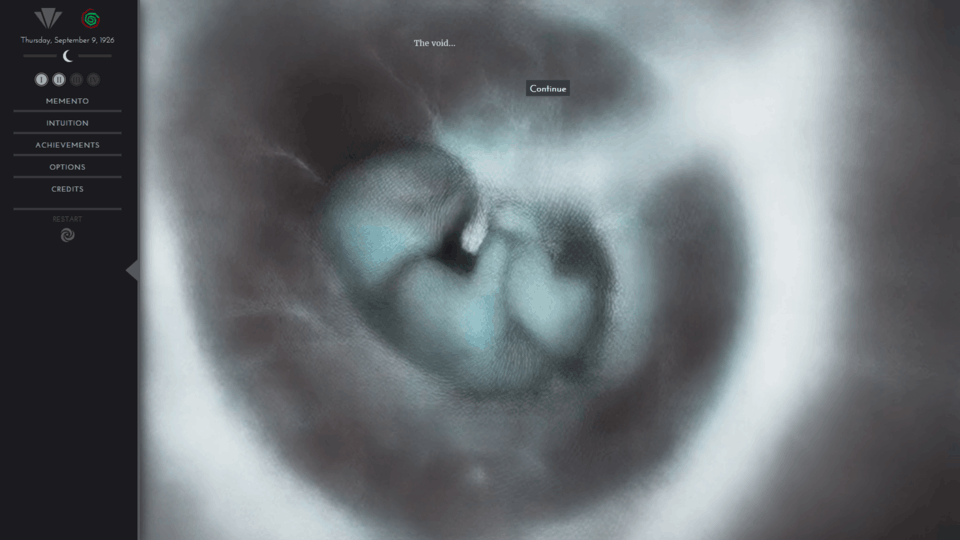
The original, and still the most ambitious. Silicon Knights’ GameCube horror introduced the “Sanity Meter” as the third stat in a Lovecraftian survival horror, and broke ground that has not been entirely retraced since. As your character’s sanity dropped — typically by being seen by enemies without retaliating — the game began to misbehave in ways aimed not at the character but at the player.
Walls bled. Statues followed you with their heads. The volume of the television seemed to drop on its own. Most famously, at very low sanity, the game would simulate a save error, a fake blue screen, or a cancelled save in progress — moments designed to make the person holding the controller, not the character on screen, question whether something was wrong. Eternal Darkness understood the trick that nobody had codified before: the most frightening sanity effects break the fourth wall, because the fourth wall is the only one the player thought was safe.
Why it matters: every sanity mechanic since exists in dialogue with Eternal Darkness. Most are gentler. None are stranger.
Frictional Games took the principle, stripped away the meta-effects, and made sanity environmental. In Amnesia, your character loses sanity by standing in darkness, by looking directly at monsters, and by witnessing disturbing events. As sanity drops, the screen distorts. Sounds intrude that aren’t sourced in the world. The camera sways. The character mutters.
The genius of Amnesia‘s system is that it makes the player complicit in their own terror: you can avoid sanity damage by hiding in the dark, but darkness itself drains sanity. You can light a lamp, but oil is finite. You can look away from the monster, but then you don’t know where it is. Every fear-mitigation strategy carries a cost in the other dimension, and the mechanic forces you to choose constantly between two kinds of fear.
Why it matters: Amnesia proved a sanity mechanic could be the central design pillar of a horror game, not a decoration.
Failbetter Games inverted the entire premise. In their interconnected gothic universe, the resource is not “sanity” but its opposite — a quality called Nightmares, which you accumulate rather than spend. Read forbidden books, see things you should not, dwell on what cannot be unseen, and your Nightmares climb. At high enough levels, you slip into a state called Wounded — and the writing of the game changes around you, the available actions shrink, and the world starts to refuse you.
What Failbetter contributed is the realisation that a sanity mechanic, in a text-driven game, can be a writing mechanic. The prose itself is what shifts. Your menu options vanish. Locations close. The story you were following becomes a story you can no longer reach. It is the most elegant integration of sanity and narrative on this list.
If you’re drawn to this kind of atmosphere, the best psychological horror games of 2026 cover much of the same ground in video game form.
Why it matters: the first proof that a sanity mechanic can drive a text-based horror experience as effectively as a 3D one — a precedent that becomes relevant again at the end of this article.
Red Hook took the sanity mechanic and made it social. In Darkest Dungeon, your characters do not lose sanity individually in private — they lose Stress, publicly, in front of each other, in the middle of a dungeon. At one hundred Stress, a character resolves: into a Virtue if you are very lucky, into an Affliction the rest of the time. Afflicted characters refuse healing, attack their own party, scream at the others, and break the formation.
What Darkest Dungeon understood is that mental collapse is not just an internal event. It is a contagion. A single Paranoid hero can drag the rest of the party down with him faster than any monster. The mechanic turns the question “is my character okay” into “is my team okay,” and that shift made the genre legible to a strategy audience that would never have played pure horror.
Why it matters: proof that sanity mechanics translate beyond first-person horror, and that the cost of insanity becomes far worse when other characters are watching it happen.
Cyanide’s adaptation of the tabletop RPG took the most direct route. Sanity is a narrative resource. You lose it by seeing what no one is meant to see. You can spend it, in effect, to access deeper truths the game otherwise withholds. The lower your sanity, the more you understand — and the less you can trust what you understand.
The implementation is more conventional than the four games above; the visuals distort, the dialogue options change, and certain endings become available only at certain mental thresholds. But the game’s tight Lovecraftian frame makes the mechanic feel correct in a way more elaborate systems sometimes do not. Sanity, in Cthulhu’s universe, is supposed to be a finite resource you spend on understanding. The game honours that.
Why it matters: the cleanest mainstream implementation of the classic Lovecraftian formula, and a useful baseline for what a “standard” sanity mechanic looks like in 2026.
Miro Haverinen’s cult RPGMaker horror duology weaponises sanity differently. The relevant stat is called Mind, and unlike the games above it does not unlock visual distortions or open dialogue paths — it simply governs whether your party members function. Lose enough Mind, and characters refuse orders, fail rolls, hallucinate enemies that aren’t there, or roll on a “Mind Insanity” table whose outcomes range from inconvenient to catastrophic.
Fear & Hunger‘s implementation is closer to a tabletop horror RPG than a video game: the system is harsh, the failure states are permanent, and recovery is rare. What it adds to this list is the principle that a sanity mechanic does not have to be visually showy to be effective. Sometimes the horror is purely procedural — the dice that decides whether your character will obey you this turn.
Why it matters: a reminder that sanity mechanics work in genres far from first-person horror, and that mechanical consequence can be as frightening as visual distortion.
The six games above share a common limitation: they all assume a screen full of 3D space or graphical assets to deform. The sanity meter affects what the camera shows, what enemies do, what dialogue offers. But there is a fifth front that has barely been explored — a sanity mechanic that operates on the text itself.
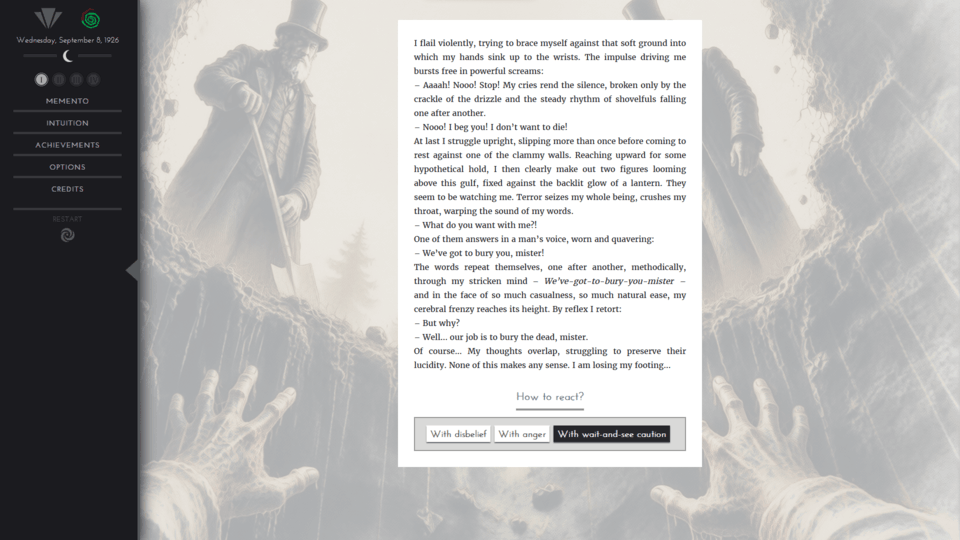
Maximilien, a psychological horror interactive novel releasing on Steam on October 26, 2026, builds its mental-state system in exactly that space. The game is set in Boston in 1926 and follows a psychology student whose grip on the investigation, and on his own perception, deteriorates across four days. Its mental-state system tracks that deterioration, and as it does, the page and the interface visibly start to fray.
The distinction matters: Maximilien‘s system does not generate new prose, rewrite scenes, or hide narrative content. The story is written, finite, and authored. What changes is the rendering: visual artifacts of different kinds build up little by little and unsettle the page and the interface, in ways the reader notices and the character does not. The words themselves never move. The effect is closer to Eternal Darkness‘s fourth-wall meta-effects than to Amnesia‘s screen distortion — except the medium being attacked is the page, not 3D space.
This is the unexplored territory the older games left behind. In a text-based horror experience, the page is the world. If the page can be made to behave wrongly, the reader experiences a form of dread no first-person engine can produce — because the reader trusts the text in a way they never trust a 3D model. Disrupting that trust is what Fallen London gestured at fifteen years ago, and what Maximilien is built to operationalise.
Beyond the visual mechanic, the system also reshapes the story branches available. Across the four days of investigation, the reader’s sanity state determines which of twelve possible endings becomes reachable — sanity is both a textural and a structural property.
Which is why Maximilien belongs alongside the other entries in our guide to the best psychological horror games of 2026.
Six games over two decades is a small sample. But the pattern across them is consistent enough to extract a principle.
The horror in a sanity mechanic does not come from the loss of agency. Plenty of games take agency away — cutscenes, scripted death, forced choice — without scaring anyone. The horror comes from a more specific feeling: the suspicion that the apparatus you are using to play the game has stopped being reliable. The camera, the interface, the prose, the rules — these are the prosthetics through which you experience the game world. When they begin to lie, the comforting separation between you and the character collapses. The character’s confused state is not something you observe; it is something you have.
This is also why most sanity mechanics fail. They put a sanity meter on the HUD, they drain it under certain conditions, and they leave the rest of the game intact. The meter becomes a puzzle to manage, not a horror to inhabit. The prosthetics keep working. Nothing breaks. The player learns the system in twenty minutes and never fears it again.
What unites the six games above — and the seventh joining them in October — is that the prosthetics themselves get sick. Walls bleed. Screens lie. Pages fray. The trust the player placed in the medium itself is the resource the mechanic actually consumes.
In horror games with a sanity mechanic, the sanity mechanic is a gameplay system that tracks a character’s mental state as a quantifiable resource, separate from health. Lower sanity typically triggers visual, auditory, narrative, or behavioural effects that change how the game is perceived or played. It is most common in horror and Lovecraftian games, where it externalises psychological deterioration as a mechanic.
Eternal Darkness: Sanity’s Requiem, released for the GameCube in 2002, is widely credited as the first major game to implement a sanity mechanic as a core design pillar. Earlier tabletop and RPG games (notably Call of Cthulhu, 1981) had used sanity scores in non-digital form for decades.
When integrated meaningfully, yes. The most effective sanity mechanics break the player’s trust in the game’s own interface — the camera, the screen, the prose, the save system — in ways that produce a more durable unease than jump scares or monster encounters. Surface-level “sanity bars” without consequence rarely add fear.
Yes. Maximilien, releasing on Steam on October 26, 2026, is built around a mental-state system in which visual artifacts build up and unsettle the page and the interface as the protagonist’s mind frays, while the words themselves never change. The system does not rewrite the story — it changes how the reader perceives a fixed, authored narrative across four days and twelve possible endings.
The terms overlap but are not identical. Stress mechanics (e.g., Darkest Dungeon) usually track short-term emotional load and recover with rest. Fear mechanics typically respond to immediate threats and reset when threats are removed. Sanity mechanics tend to track long-term mental deterioration, recover slowly or not at all, and affect perception rather than just performance.
Horror games that scare you with what’s in the next room are easy to forget once the credits roll. The room is closed. The monster is gone. You stop playing, and the game stops mattering. Horror games that scare you with what’s in you — that have made you doubt, even briefly, the interface you used to play them — leave a longer mark. The six games above are remembered for that reason. The seventh, releasing in October 2026, is built specifically to extend the principle into a medium the others couldn’t reach.